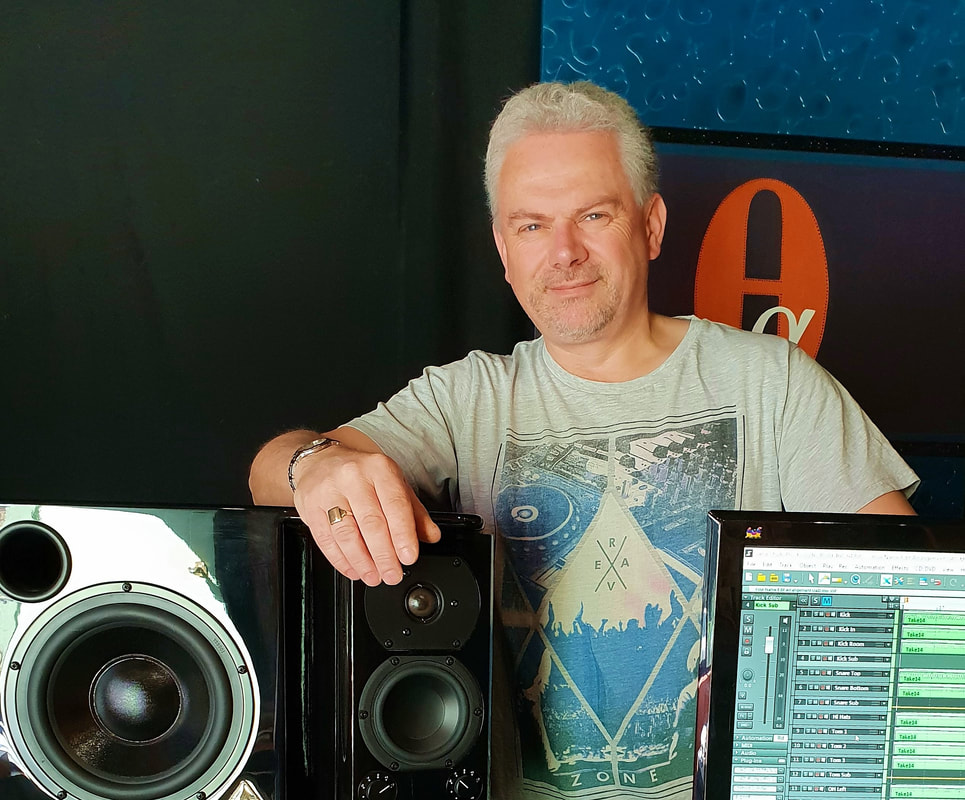
 Tim Julian
 Mastering? If there's any part of recording that confuses people it's mastering. When I get to boring folk with talk of the new recording, the question I hear most often is “what is mastering?”.
So let me have a quick run at this – and I will keep it brief since it can be the sort of technical thing that makes eyes glaze over pretty quickly. I'll do my best not to make it too boringly nerdy despite my ever-present nerdish tendencies.
Basically mastering is the icing on the cake of a recording, a sort of brush and polish that happens after the recording is mixed. So what does that mean?
In our case, Nigel and I recorded and mixed Workhorse at the Boatshed Studio in Whakamarama and then sent it across town to Tim Julian at The Colourfield in Welcome Bay, who has all sorts of flash specialist equipment for mastering that Nigel doesn't at The Boatshed.
At its most basic, mastering will do this:
The way mastering makes the recording louder is essentially by applying compression. Compression is where you squash down the loudest bits. That means you can then turn the overall volume up without those peaks being too loud and distorting.
There has been much complaint in recent years that to get songs as loud as possible – to stand out better on phones through headphones - too much compression has been used and the music has lost its dynamics (no loud and quiet). We wholeheartedly agree. Consequently we try and compress as little as possible to allow for dynamics. Our albums may be a little quieter than some but we like the sound better.
It is also possible to aim this compression quite specifically so it will affect only certain frequencies or certain places in the mix (e.g. just the left and right of the mix so it doesn't affect the voice in the middle). Tim regularly uses this to “tighten up” the bass sound, getting the low frequencies to be more punchy. He also uses it to add “sparkle” at the top making things like cymbals and tambourines a little more vibrant.
So let me have a quick run at this – and I will keep it brief since it can be the sort of technical thing that makes eyes glaze over pretty quickly. I'll do my best not to make it too boringly nerdy despite my ever-present nerdish tendencies.
Basically mastering is the icing on the cake of a recording, a sort of brush and polish that happens after the recording is mixed. So what does that mean?
In our case, Nigel and I recorded and mixed Workhorse at the Boatshed Studio in Whakamarama and then sent it across town to Tim Julian at The Colourfield in Welcome Bay, who has all sorts of flash specialist equipment for mastering that Nigel doesn't at The Boatshed.
At its most basic, mastering will do this:
- make all the songs of equal volume
- make that volume as loud as possible (so your songs aren't quieter than other songs on the radio or Spotify etc)
- even up the frequencies (rooting out any harsh tones that have slipped through, adding a little more of anything that's missing)
- make sure that each song has the same frequency balance (the same levels of bottoms/bass, mids, and tops/high frequency
The way mastering makes the recording louder is essentially by applying compression. Compression is where you squash down the loudest bits. That means you can then turn the overall volume up without those peaks being too loud and distorting.
There has been much complaint in recent years that to get songs as loud as possible – to stand out better on phones through headphones - too much compression has been used and the music has lost its dynamics (no loud and quiet). We wholeheartedly agree. Consequently we try and compress as little as possible to allow for dynamics. Our albums may be a little quieter than some but we like the sound better.
It is also possible to aim this compression quite specifically so it will affect only certain frequencies or certain places in the mix (e.g. just the left and right of the mix so it doesn't affect the voice in the middle). Tim regularly uses this to “tighten up” the bass sound, getting the low frequencies to be more punchy. He also uses it to add “sparkle” at the top making things like cymbals and tambourines a little more vibrant.

Tim Julian again!
Of course you can really go to town with mastering by adding targeted effects. For instance, if you have a guitar part on the right hand side that is predominantly at a specific frequency, you could target effects – chorus, reverb, whatever – to that particular frequency specifically on the right hand side and essentially change the sound or volume of that instrument alone. So you can do all sorts of clever stuff, depending on how much time and money you have to throw at it....
But we keep it simple. We look to Tim for just the icing on the cake. We've already baked the damn thing at great length and it's just the way we wanted it so Tim just adds that extra 5% of fairy dust. And every bit of magic helps!
Just as an example - here's a minute of I'm Going Fishing - first verse unmastered, second verse mastered. It's quite a difference!
But we keep it simple. We look to Tim for just the icing on the cake. We've already baked the damn thing at great length and it's just the way we wanted it so Tim just adds that extra 5% of fairy dust. And every bit of magic helps!
Just as an example - here's a minute of I'm Going Fishing - first verse unmastered, second verse mastered. It's quite a difference!



 RSS Feed